Most marriages don’t fall apart over the big things.
They fall apart over the small, unspoken ones. The silence at the kitchen table when the credit card statement arrives. The way a husband stops making eye contact when his wife asks about the bills. The way she stops asking because the answer always hurts him more than it helps her.
I know this because I lived it.
For years in my marriage, I carried a weight I had never been taught to name. The weight of being “the provider.” The weight of believing that if I couldn’t produce enough money, I wasn’t enough of a man. The weight of a lie I didn’t even know I was living under.
That lie almost ended my marriage. And it was never the lie I thought it was.
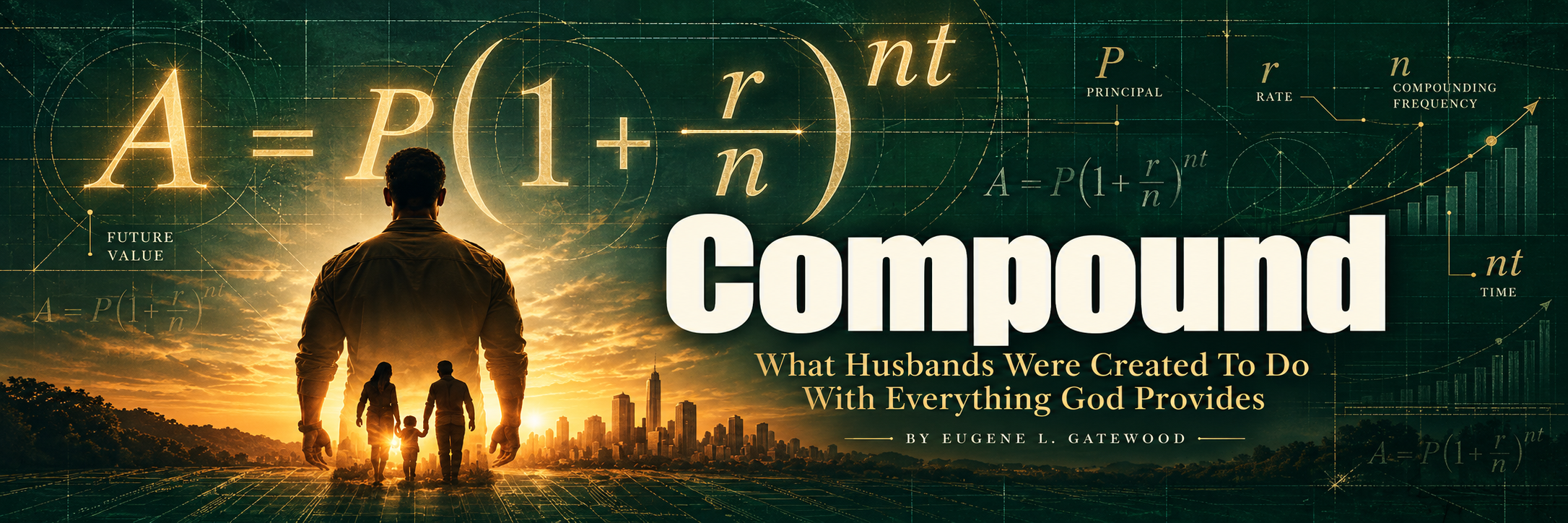
That is why I wrote COMPOUND.
This Is Not A Finance Book
Let me say that clearly before you keep reading, because the title can mislead.
COMPOUND is not about budgeting. It is not about investing. It is not about getting out of debt or building wealth. Those are good things, and there are good books that teach them. COMPOUND is a book about identity.
Specifically, it is about the identity most married men have been handed without their consent…the identity of “the provider”, and the quiet damage it is doing to their marriage, their peace, and the men they were created to be.
The thesis of the book is one sentence:
Compound is about who you are becoming, so money does not have the ability to redefine who you are.
That sentence is for every husband who has woken up at 3am worried about how he will make ends meet. It is for every wife who has watched her husband disappear inside his own head over a financial problem she would have gladly walked through with him if he had let her. And it is for every couple who has felt the slow, strange distance that money problems create…not because they stopped loving one another, but because one person started carrying something that was never meant to be carried alone.
What The Book Teaches
I wrote COMPOUND around a single reassignment.
For most married men, the operating belief is: I am the provider. Everything depends on me. That belief feels responsible. It feels mature. It feels like what a good husband is supposed to carry.
But Scripture never gave husbands that assignment. Scripture gave us a different one.
“It is the Lord your God who gives you the ability to produce wealth.”
— Deuteronomy 8:18
Key words…GOD GIVES…God is the Provider. The husband is the steward and the multiplier. Those are completely different roles, and getting them confused is what costs men their peace, their marriages, and sometimes their faith.
The book walks a husband through five identity stages, from the striving man who believes everything depends on him, to the legacy builder who makes decisions with his grandchildren in mind.
Each stage comes with practical teaching: the seven biblical laws of stewardship, the three-bucket system for managing a household, the three conversations every couple needs to have about money, and the G.R.A.C.E. meeting that gives a husband and wife a shared language for leading their finances together.
But every piece of practical teaching sits on top of the one truth that holds the whole book together.
You were never the Provider. You were created to be the steward (or manager) of what the Provider has already given you.
What This Means For Your Marriage
If you are a wife reading this, here is what I want you to know.
Your husband is probably carrying more than he has told you. Not because he does not trust you. Because he does not know how to put down something he believes is his alone to hold. He is not shutting you out on purpose. He is trying to protect you from a weight he thinks is his job to bear. And it is slowly costing both of you.
COMPOUND gives him a different frame. It gives him language for the lie he has been living under. And it gives both of you a path to leading your household’s finances as a team instead of as one spent husband and one locked-out wife.
If you are a husband reading this, here is what I want you to know.
You are not failing. You are operating under the wrong assignment. The weight you have been trying to carry alone was never yours in the first place. God gave you one job in your household’s finances…to be faithful with what He has already provided and to multiply it in His name. He kept the role of Provider for Himself. When you stop trying to steal that role from Him, three things come back to you: your peace, your partner, and the man you were created to be.
If you are a pastor, counselor, or small group leader reading this, here is what I want you to know.
The marriages in your care are being quietly dismantled by a theology nobody preaches but almost every husband believes. The theology that he is the source. COMPOUND is written to help you give the husbands in your care the reassignment Scripture always intended for them, in a format they can actually read and apply. The book has a companion workbook, a participant guide, and a facilitator guide for small groups. If you lead men, this can be the resource that changes how you lead them.
Why Now?
I was never going to write this book.
I spent twenty-plus years in ministry teaching men how to be husbands. The whole time, I was quietly carrying a financial weight I would not let my own wife touch. I taught classes on stewardship and did secret math at 3am, trying to figure it out alone. The disconnect between what I taught and what I lived finally forced me to a question I had been avoiding for a decade.
What is money actually for in a marriage?
The answer broke me open. It took me from carrying my household alone to leading it with my wife. It took us from the brink of something we could not come back from to the marriage I live in now. And it gave me the framework I spent the last five years building into the book that drops today.
COMPOUND is here because every husband I know is quietly carrying something he was never designed to carry. And every wife I know is quietly watching him do it. We were created for something better. So was your marriage.
The Book Is Live Today
COMPOUND: What Husbands Were Created To Do With Everything God Provides is available now at CompoundTheBook.com.
If you have been part of this community for any length of time, you know I do not write to add to the noise. I write when something has been quietly killing the marriages I love and nobody has given it a name. This book names it.
Get your copy at CompoundTheBook.com.
Read it this weekend. Bring it to your spouse. Then come find me in The Compounders community at CompoundTheBook.APP and tell me what shifted.
You’re Already Equipped. Go Compound.
Eugene


