Posts Tagged ‘Criteria of a good husband’


Most marriages don’t fall apart over the big things.

They fall apart over the small, unspoken ones. The silence at the kitchen table when the credit card statement arrives. The way a husband stops making eye contact when his wife asks about the bills. The way she stops asking because the answer always hurts him more than it helps her.

I know this because I lived it.

For years in my marriage, I carried a weight I had never been taught to name. The weight of being “the provider.” The weight of believing that if I couldn’t produce enough money, I wasn’t enough of a man. The weight of a lie I didn’t even know I was living under.

That lie almost ended my marriage. And it was never the lie I thought it was.

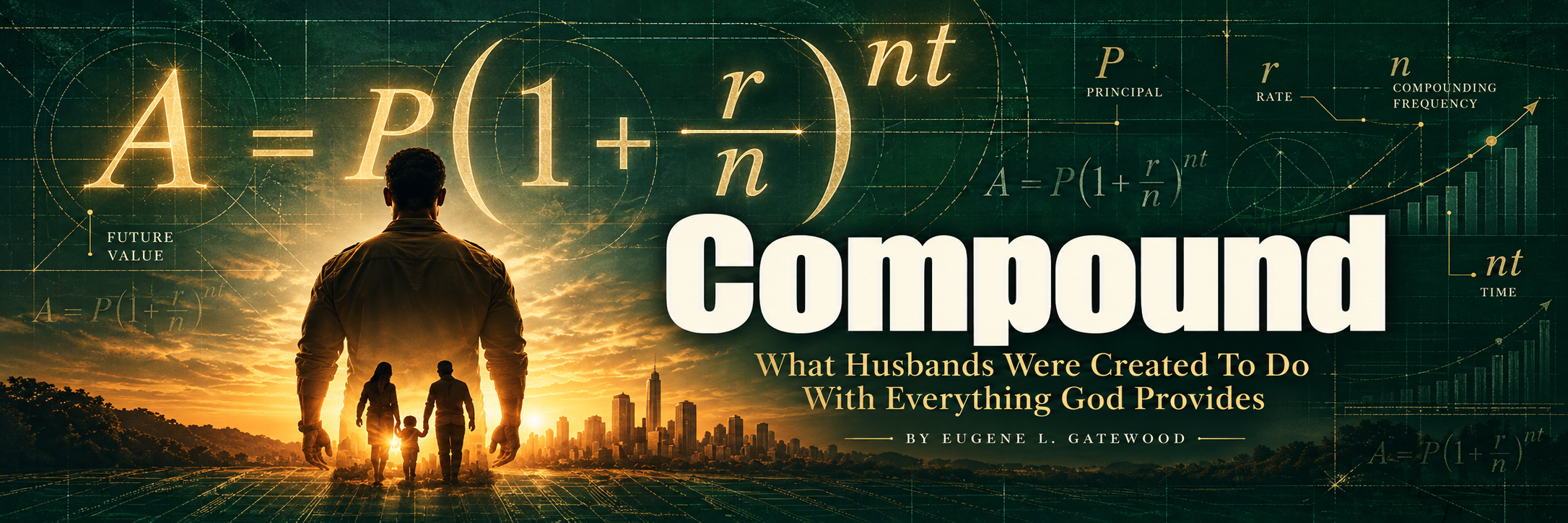
That is why I wrote COMPOUND.

This Is Not A Finance Book

Let me say that clearly before you keep reading, because the title can mislead.

COMPOUND is not about budgeting. It is not about investing. It is not about getting out of debt or building wealth. Those are good things, and there are good books that teach them. COMPOUND is a book about identity.

Specifically, it is about the identity most married men have been handed without their consent…the identity of “the provider”, and the quiet damage it is doing to their marriage, their peace, and the men they were created to be.

The thesis of the book is one sentence:

Compound is about who you are becoming, so money does not have the ability to redefine who you are.

That sentence is for every husband who has woken up at 3am worried about how he will make ends meet. It is for every wife who has watched her husband disappear inside his own head over a financial problem she would have gladly walked through with him if he had let her. And it is for every couple who has felt the slow, strange distance that money problems create…not because they stopped loving one another, but because one person started carrying something that was never meant to be carried alone.

What The Book Teaches

I wrote COMPOUND around a single reassignment.

For most married men, the operating belief is: I am the provider. Everything depends on me. That belief feels responsible. It feels mature. It feels like what a good husband is supposed to carry.

But Scripture never gave husbands that assignment. Scripture gave us a different one.

“It is the Lord your God who gives you the ability to produce wealth.”
— Deuteronomy 8:18

Key words…GOD GIVES…God is the Provider. The husband is the steward and the multiplier. Those are completely different roles, and getting them confused is what costs men their peace, their marriages, and sometimes their faith.

The book walks a husband through five identity stages, from the striving man who believes everything depends on him, to the legacy builder who makes decisions with his grandchildren in mind.

Each stage comes with practical teaching: the seven biblical laws of stewardship, the three-bucket system for managing a household, the three conversations every couple needs to have about money, and the G.R.A.C.E. meeting that gives a husband and wife a shared language for leading their finances together.

But every piece of practical teaching sits on top of the one truth that holds the whole book together.

You were never the Provider. You were created to be the steward (or manager) of what the Provider has already given you.

What This Means For Your Marriage

If you are a wife reading this, here is what I want you to know.

Your husband is probably carrying more than he has told you. Not because he does not trust you. Because he does not know how to put down something he believes is his alone to hold. He is not shutting you out on purpose. He is trying to protect you from a weight he thinks is his job to bear. And it is slowly costing both of you.

COMPOUND gives him a different frame. It gives him language for the lie he has been living under. And it gives both of you a path to leading your household’s finances as a team instead of as one spent husband and one locked-out wife.

If you are a husband reading this, here is what I want you to know.

You are not failing. You are operating under the wrong assignment. The weight you have been trying to carry alone was never yours in the first place. God gave you one job in your household’s finances…to be faithful with what He has already provided and to multiply it in His name. He kept the role of Provider for Himself. When you stop trying to steal that role from Him, three things come back to you: your peace, your partner, and the man you were created to be.

If you are a pastor, counselor, or small group leader reading this, here is what I want you to know.

The marriages in your care are being quietly dismantled by a theology nobody preaches but almost every husband believes. The theology that he is the source. COMPOUND is written to help you give the husbands in your care the reassignment Scripture always intended for them, in a format they can actually read and apply. The book has a companion workbook, a participant guide, and a facilitator guide for small groups. If you lead men, this can be the resource that changes how you lead them.

Why Now?

I was never going to write this book.

I spent twenty-plus years in ministry teaching men how to be husbands. The whole time, I was quietly carrying a financial weight I would not let my own wife touch. I taught classes on stewardship and did secret math at 3am, trying to figure it out alone. The disconnect between what I taught and what I lived finally forced me to a question I had been avoiding for a decade.

What is money actually for in a marriage?

The answer broke me open. It took me from carrying my household alone to leading it with my wife. It took us from the brink of something we could not come back from to the marriage I live in now. And it gave me the framework I spent the last five years building into the book that drops today.

COMPOUND is here because every husband I know is quietly carrying something he was never designed to carry. And every wife I know is quietly watching him do it. We were created for something better. So was your marriage.

The Book Is Live Today

COMPOUND: What Husbands Were Created To Do With Everything God Provides is available now at CompoundTheBook.com.

If you have been part of this community for any length of time, you know I do not write to add to the noise. I write when something has been quietly killing the marriages I love and nobody has given it a name. This book names it.

Get your copy at CompoundTheBook.com.

Read it this weekend. Bring it to your spouse. Then come find me in The Compounders community at CompoundTheBook.APP and tell me what shifted.

You’re Already Equipped. Go Compound.

Eugene


Why is communication so hard in marriage?
Want tips on how to improve YOUR SPOUSES communication? Go grab your spouse & CLICK IMAGE to watch the full episode together.

Communication stands as one of the most fundamental pillars of a successful marriage, yet it remains one of the greatest challenges couples face. Why is something so essential simultaneously so difficult? This paradox exists because true communication extends far beyond merely exchanging words…it’s about creating connection, understanding, and safety.

Many couples operate under the illusion that communication is happening simply because words are being exchanged. However, research shows that only 7% of what WE communicate comes from our actual words…the remaining 93% stems from our tone and body language. This highlights why so many marriages struggle with miscommunication; spouses may be talking but not truly communicating.

True communication requires active engagement, intention, and attention. It’s the difference between merely hearing words and truly listening to understand. In our digital age, where so much interaction happens through text messages and social media, the absence of tone and body language creates even greater opportunity for misinterpretation and disconnection. WE‘ve become accustomed to superficial exchanges that lack depth, leaving our intimate relationships starved for meaningful connection.

Creating a safe space forms the foundation for effective marital communication. A safe space isn’t just about physical safety, but emotional, mental, and spiritual safety as well. It’s an environment where both partners feel free to express fears, needs, and failures without judgment. They feel accepted rather than expected to be perfect, and covered with grace rather than criticism. The challenge is that many people don’t recognize what a safe space truly is, making it impossible to create one for their spouse.

Unhealed trauma significantly impacts our ability to communicate effectively in marriage. Trauma doesn’t just alter how WE feel…it rewires our brain to detect threats even in peaceful situations. This explains why some individuals create chaos even when surrounded by calm; they’ve become accustomed to turbulence. Even when a spouse genuinely offers safety, a traumatized heart might still perceive danger, creating a significant communication barrier that has nothing to do with the words being exchanged.

Our heart condition directly influences our communication style. Scripture reminds us that “a good man brings good things out of the good stored up in his heart… for the mouth speaks what the heart is full of” (Luke 6:45). Before blaming communication problems on your spouse, examine what’s in your own heart. Are you harboring resentment, unforgiveness, or pride? These internal issues will inevitably surface in your communication patterns.

Pride presents one of the greatest obstacles to effective communication. When being right becomes more important than being understood; when winning arguments takes precedence over resolving conflicts; partnership becomes impossible. Especially in Christian marriages, pride often masquerades as self-righteousness, turning what should be collaboration into competition.

Interestingly, many couples exhibit more patience and effort communicating with strangers than with their own spouses. Consider how attentively you would listen to someone speaking a different language…the focus, patience, and determination to understand. Yet with our spouses, WE often multitask, half-listen, or prepare our rebuttals instead of truly seeking to understand.

For those preparing for marriage, recognize that communication skills aren’t automatic, they require continuous development. Don’t assume love equals understanding, pay attention to how you handle conflict, ensure you share values and vision, practice vulnerability, seek healthy role models, and discuss how you’ll handle disagreements before they arise.

The journey toward better communication is ongoing, requiring daily commitment regardless of feelings. The good news is that with intentional effort, couples can develop deeper understanding, greater intimacy, and more effective conflict resolution skills that strengthen their marriage over a lifetime.

Want tips on how to improve YOUR SPOUSES communication? Click below, tag your spouse and watch the full episode together. Subscribe, Like & Share!


In today’s culture, WE‘re bombarded with idealized versions of love and marriage through media, movies, and music. These romantic notions create expectations that often lead to disappointment when real relationships don’t match these fairytales. On the latest episode of WE3 The Winning Team Podcast, WE explored three prevalent myths about relationships that can actually hinder your journey to a healthy, lasting marriage.

The first myth WE tackled was “opposites attract.” This widely accepted belief suggests that people who are fundamentally different naturally gravitate toward each other, creating an exciting dynamic. While initial chemistry between different personalities can feel thrilling—like when an introvert meets an extrovert or a spontaneous person connects with someone structured—these differences often become sources of conflict over time. What matters more than surface-level differences are shared core values, goals, and communication styles. A relationship built on complementary strengths can work beautifully, but when foundational values differ dramatically, the relationship faces constant friction. Remember: compatibility isn’t about being identical, but about having the temperament and personality to navigate life together effectively.

The second myth WE explored was the concept of “soulmates”—the idea that there’s one perfect person divinely created just for you. This notion creates unrealistic expectations about relationships being effortless and magical. When relationships require work (as they all do), people questioning whether they truly found their “soulmate” might abandon potentially wonderful partnerships. From a biblical perspective, Scripture doesn’t teach the concept of predetermined soulmates, but rather emphasizes choosing a Godly spouse and building a strong marriage based on biblical principles of being like Jesus. The logical problem with soulmates is clear: if there’s only one perfect match for each person, what happens when someone marries the “wrong” person? Would everyone else in the chain of relationships be doomed to mismatches? Real love isn’t about finding a mythical perfect match—it’s about commitment, acceptance, and creating safety for each other to grow authentically.

Perhaps the most pervasive myth is “love at first sight.” This romantic notion suggests that true love can be recognized instantly, but this confuses intense attraction with genuine love. That first “spark” is actually just dopamine flooding your brain, creating intense emotions that feel significant. But biblical love—patient, kind, not easily angered—cannot exist without shared experiences and time. How can you know if someone is patient if you’ve never seen them tested? How can you know they’re kind if you haven’t witnessed their response to others in various situations? People who constantly chase this feeling become “dopamine hunters,” abandoning relationships when the initial intensity fades, rather than putting in the work needed for lasting connection.

The biblical perspective offers a healthier framework. Proverbs 18:22 says, “He who finds a wife finds a good thing and obtains favor from the Lord.” There’s an important distinction between “finding” and “searching.” Searching implies striving or desperation, while finding suggests discovery while walking in your purpose. Just as Adam didn’t frantically search for Eve but was doing his purpose when God brought her to him, men should focus on seeking God first, developing character and purpose, and being in the right spiritual place. Similarly, women should position themselves by focusing on their relationship with God, developing godly character, and being in environments aligned with their values.

CLICK HERE to watch episode two, to gain more insights on each myth. Also, we included a list of thought provoking questions that you can answer for yourself or ask your partner to get to know more about how they feel about you and your relationship.

Eugene & LaTanya Gatewood | WE3 The Winning Team